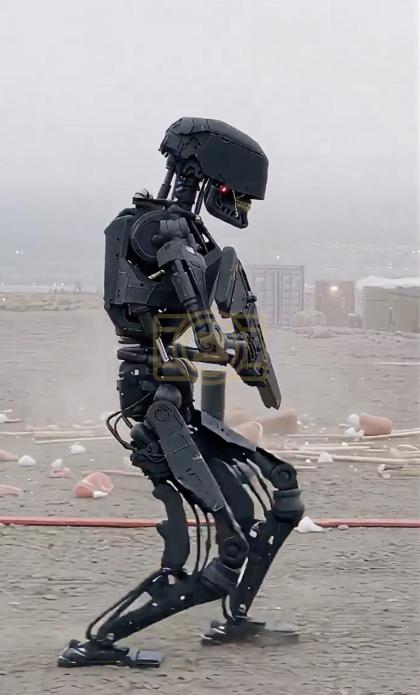
ARMED HUMANOID ROBOT SPARKS FEARS: Video Shows Machine Sprinting, Crouching and Firing Belt-Fed Weapon
Gallery
Videos
A disturbing video circulating online shows a black skeletal humanoid robot sprinting across a military-style test range, dropping into a crouched firing position, and unleashing rounds from a belt-fed machine gun. Wearing a numbered helmet marked “30,” the machine moves through the exercise with mechanical precision, while an explosion erupts on the ground behind it. The footage features the words “Terror Projection Unit Evaluation,” raising questions about the purpose of the demonstration and the potential military applications of increasingly advanced humanoid robotics. What makes the footage particularly unsettling is not simply the weapon in the robot's hands, but how effortlessly it appears to carry out the sequence without hesitation. Unlike human soldiers, machines do not naturally experience fear, uncertainty, or the emotional hesitation that can influence decisions in life-threatening situations. The demonstration offers a striking illustration of how physical AI could eventually combine human-like mobility with potentially dangerous capabilities.
As humanoid robotics and artificial intelligence continue advancing, the footage raises a much broader question about the role of human judgment in autonomous military systems. Human hesitation can sometimes lead to mistakes, but it can also provide an opportunity to reconsider an action, recognize a civilian threat, or prevent unnecessary harm. A machine that can move, aim, and fire with extreme speed presents a different set of challenges if its actions are not subject to meaningful human oversight. Military applications of AI therefore raise critical questions about accountability, the limits of autonomous weapons, and who ultimately makes the decision to use lethal force. Although the video does not establish whether the robot independently selected its targets or operated under human control, its capabilities highlight the importance of defining strict boundaries for military robotics. As physical AI becomes increasingly sophisticated, the central challenge may not simply be teaching machines how to act like humans, but ensuring they are designed to recognize when they must stop.