HUMANOID ROBOT BREAKTHROUGH: NVIDIA's GR00T 2 Turns Unitree Humanoid Robots Into Team Players as Two Machines Work Together to Serve Popcorn
Gallery
Videos
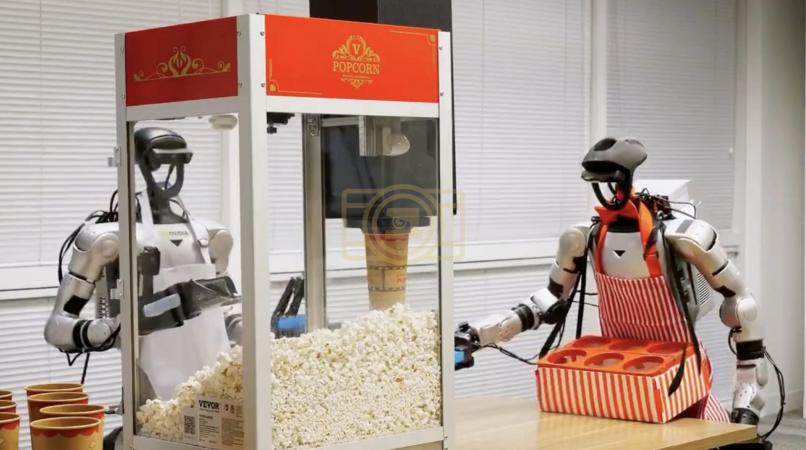
NVIDIA is showcasing another step toward practical humanoid robotics with a demonstration of two Unitree G1 robots working together to prepare and deliver popcorn using its GR00T 2 Turbo model. In the demonstration, one humanoid robot operates the popcorn machine, scooping and filling containers, while the second receives the finished cups in a storage tray mounted on its chest before carrying them away. The coordinated performance highlights the robots' ability to combine object manipulation, movement, and task-sharing rather than simply performing isolated actions. NVIDIA's GR00T 2, announced on November 9, 2026, is a world-action model designed to help humanoid robots understand their surroundings and perform physical tasks using human demonstration videos and robot training data. According to the provided specifications, the system can achieve a reported 95% success rate on new tasks after just five demonstrations and approximately 30 minutes of fine-tuning. Running on the Unitree G1's NVIDIA Jetson Thor computing platform, the GR00T 2 Turbo model reportedly delivers real-time predictions with approximately 124 milliseconds of latency.
The demonstration offers a glimpse into how humanoid robots could eventually become part of everyday service operations, particularly in restaurants, movie theaters, amusement parks, and other customer-facing businesses. Rather than relying entirely on human employees for repetitive activities, businesses could potentially deploy coordinated robotic workers to handle food preparation, product delivery, and routine service tasks. The ability of two robots to divide responsibilities and cooperate on a shared objective is particularly significant because real-world workplaces often require multiple machines to interact with the same environment. NVIDIA's approach also aims to reduce the amount of task-specific training needed before robots can adapt to unfamiliar assignments. However, demonstrations in controlled environments do not necessarily establish that the technology is ready for widespread commercial deployment, where safety, reliability, operating costs, and unpredictable customer interactions remain important challenges. Nevertheless, the popcorn demonstration illustrates how advances in physical AI could bring humanoid robotics closer to practical applications beyond factories and research laboratories.