VENEZUELA OIL: Trump To Meet With Refinery Executives Following Historic $65 Billion Deal

Gallery
Videos
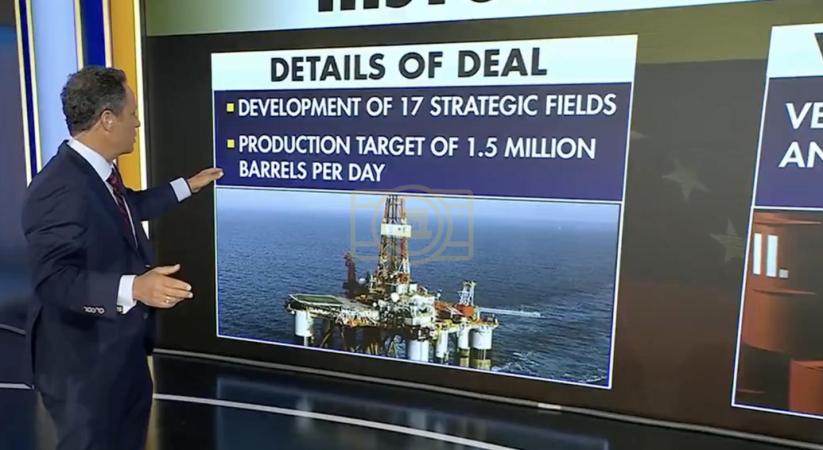
President Trump is set to meet with top U.S. oil refinery executives in the wake of what he has called the "biggest oil deal in world history," a sweeping 25-year agreement granting the United States significant control over Venezuela's vast oil reserves. Announced via Truth Social, the deal covers seventeen strategic oil fields holding a proven potential of 65 billion barrels, more than doubling current U.S. oil reserves according to Trump's own characterization. The agreement was reportedly negotiated by Secretary of State Marco Rubio and Defense Secretary Pete Hegseth alongside Venezuela's acting president, Delcy Rodríguez, who has publicly praised the deal as a turning point for her country's economic recovery.
Under the terms of the arrangement, the United States will partner with a private Venezuelan operator to form a new joint venture, with the U.S. holding a 55 percent effective stake split between equity ownership and production rights. That structure would make the new entity the second-largest private oil company in the world by reserves, according to a U.S. official familiar with the deal. Rodríguez's government estimates the agreement could draw more than $100 billion in fresh investment into Venezuela's long-neglected oil sector while generating upwards of $209 billion in tax revenue for Caracas over the life of the contract. The interim president has stressed that the deal will not compromise Venezuela's sovereignty over its natural resources, framing it instead as a mutually beneficial partnership.
The timing of the agreement follows a dramatic shift in Venezuela's political landscape, coming months after U.S. forces captured former President Nicolás Maduro in a targeted raid and brought him to the United States to face federal drug-trafficking charges. In the aftermath of that operation, Trump gathered oil executives at the White House to encourage renewed investment in Venezuela's oil industry, though some, including ExxonMobil's chairman, had previously described the country's legal and commercial environment as effectively "uninvestable." The new deal appears designed to directly address those concerns by offering a clearer framework and long-term security for companies willing to commit capital to rebuilding the country's aging infrastructure.
Despite Trump's insistence that the agreement will "substantially lower gas prices for all Americans," experts caution that meaningful relief at the pump is unlikely to arrive quickly. The deal centers on the development of undeveloped oil fields rather than immediate access to already-refined crude, and Venezuela's dilapidated production infrastructure will require years and billions of dollars in investment before output can meaningfully increase. Officials have set a production target of more than 1.5 million barrels per day under the bilateral agreement, a substantial jump from the country's current output but one that industry analysts say will take considerable time to achieve. As Trump moves forward with meetings alongside refinery executives, the real test of the deal's impact, both for American consumers and for Venezuela's long-suffering economy, still lies ahead.