צה"ל הארגעט א חיזבאללה עקטאר
The Israel Defense Forces conducted a precision airstrike overnight in the southern Lebanese town of at-Tiri, eliminating a Hezbollah operative involved in rebuilding the group’s military infrastructure, according to official Israeli statements. Lebanon’s health ministry confirmed one fatality following the strike, which Israeli officials say was carried out in response to activity that violated the standing Israel-Lebanon ceasefire framework.
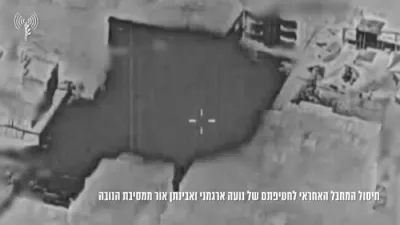
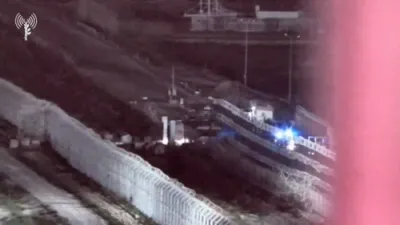
Israeli military sources indicated that the targeted individual was directly engaged in efforts to restore Hezbollah operational capabilities in the border region, including work tied to logistical and structural assets used for militant activity. The strike was executed using real-time intelligence and aerial surveillance, with thermal drone footage showing a single structure engulfed in flames after the impact—evidence of a focused operation designed to minimize collateral damage while neutralizing a specific threat.
From Israel’s perspective, the action reflects a consistent enforcement policy aimed at preventing Hezbollah from reestablishing military infrastructure near the northern border. Israeli defense doctrine has long emphasized preemptive disruption of weapons storage sites, command nodes, and reconstruction efforts that could enhance the group’s ability to conduct cross-border attacks. Officials have repeatedly warned that any attempt by Hezbollah to rebuild combat capabilities in violation of ceasefire understandings would trigger targeted responses.
The strike comes amid persistent tensions along the Israel-Lebanon frontier, where Hezbollah has sought to maintain a forward presence despite international agreements intended to limit armed activity south of the Litani River. Israeli intelligence assessments have pointed to ongoing efforts by the organization to repair damaged facilities, reposition assets, and improve operational readiness following previous exchanges. By targeting a figure linked to these activities, Israel is signaling that reconstruction itself can constitute a trigger for military action when tied to hostile intent.
Operationally, the use of precision airpower underscores Israel’s reliance on intelligence-driven targeting to manage escalation while avoiding broader conflict. Nighttime engagement, combined with surveillance confirmation, indicates a calibrated approach designed to eliminate a specific operative without expanding the scope of hostilities. This model has become a central component of Israel’s campaign to contain Hezbollah’s military entrenchment while maintaining strategic deterrence.
Hezbollah has not issued a detailed response at the time of reporting, but past patterns suggest the group may weigh retaliation against the risk of a larger confrontation. The current environment remains highly sensitive, with both sides operating under a framework of controlled friction that stops short of full-scale war but includes periodic strikes and counter-measures.
The incident also highlights the ongoing fragility of the ceasefire arrangement. While the agreement is intended to prevent the reintroduction of armed infrastructure in southern Lebanon, enforcement mechanisms remain limited, placing the burden largely on Israeli intelligence and military action. Each targeted strike therefore serves both an operational and signaling function: removing an immediate threat while reinforcing red lines intended to deter future violations.
As regional dynamics continue to shift, the balance between deterrence and escalation will remain a defining feature of the Israel-Hezbollah theater. The at-Tiri strike demonstrates Israel’s willingness to act against reconstruction activities it views as militarization, reinforcing a policy that treats infrastructure rebuilding as part of the threat matrix rather than a post-conflict recovery effort.
In strategic terms, the operation reflects a broader Israeli objective—to prevent Hezbollah from regaining the proximity, firepower, and logistical depth that could threaten northern communities. By maintaining pressure on emerging infrastructure and the personnel responsible for it, Israel aims to preserve a security buffer while avoiding the conditions that could lead to a wider war.